Regulation of Memory Formation by the Transcription Factor XBP1.
- Martínez G Biomedical Neuroscience Institute, Faculty of Medicine, University of Chile, Santiago, Chile; Program of Cellular and Molecular Biology, Institute of Biomedical Sciences, Center for Molecular Studies of the Cell, University of Chile, Santiago, Chile; Center for Geroscience, Brain Health and Metabolism, Santiago, Chile.
- Vidal RL Biomedical Neuroscience Institute, Faculty of Medicine, University of Chile, Santiago, Chile; Center for Geroscience, Brain Health and Metabolism, Santiago, Chile; Neurounion Biomedical Foundation, CENPAR, Santiago, Chile.
- Mardones P Biomedical Neuroscience Institute, Faculty of Medicine, University of Chile, Santiago, Chile; Program of Cellular and Molecular Biology, Institute of Biomedical Sciences, Center for Molecular Studies of the Cell, University of Chile, Santiago, Chile; Center for Geroscience, Brain Health and Metabolism, Santiago, Chile.
- Serrano FG Center of Aging and Regeneration (CARE), Department of Cell and Molecular Biology, Faculty of Biological Sciences, Pontifical Catholic University of Chile, Santiago, Chile.
- Ardiles AO Centro Interdisciplinario de Neurociencia de Valparaíso, Facultad de Ciencias, Universidad de Valparaíso, Valparaiso, Chile.
- Wirth C Department of Immunology and Infectious Diseases, Harvard School of Public Health, Boston, MA 02115, USA.
- Valdés P Biomedical Neuroscience Institute, Faculty of Medicine, University of Chile, Santiago, Chile; Program of Cellular and Molecular Biology, Institute of Biomedical Sciences, Center for Molecular Studies of the Cell, University of Chile, Santiago, Chile; Center for Geroscience, Brain Health and Metabolism, Santiago, Chile.
- Thielen P Department of Immunology and Infectious Diseases, Harvard School of Public Health, Boston, MA 02115, USA.
- Schneider BL Brain Mind Institute, Ecole Polytechnique Fédérale de Lausanne (EPFL), 1015 Lausanne, Switzerland.
- Kerr B Centro de Estudios Científicos, Valdivia, Chile.
- Valdés JL Biomedical Neuroscience Institute, Faculty of Medicine, University of Chile, Santiago, Chile; Programa Disciplinario de Fisiología y Biofísica, I.C.B.M., Facultad de Medicina, Universidad de Chile, Santiago, Chile.
- Palacios AG Centro Interdisciplinario de Neurociencia de Valparaíso, Facultad de Ciencias, Universidad de Valparaíso, Valparaiso, Chile.
- Inestrosa NC Center of Aging and Regeneration (CARE), Department of Cell and Molecular Biology, Faculty of Biological Sciences, Pontifical Catholic University of Chile, Santiago, Chile.
- Glimcher LH Weill Cornell Medical College, New York, NY 10065, USA. Electronic address: lglimche@med.cornell.edu.
- Hetz C Biomedical Neuroscience Institute, Faculty of Medicine, University of Chile, Santiago, Chile; Program of Cellular and Molecular Biology, Institute of Biomedical Sciences, Center for Molecular Studies of the Cell, University of Chile, Santiago, Chile; Center for Geroscience, Brain Health and Metabolism, Santiago, Chile; Department of Immunology and Infectious Diseases, Harvard School of Public Health, Boston, MA 02115, USA. Electronic address: chetz@med.uchile.cl.
- 2016-02-09
Published in:
- Cell reports. - 2016
Animals
Brain-Derived Neurotrophic Factor
Diacylglycerol O-Acyltransferase
Endoplasmic Reticulum
Endoplasmic Reticulum Stress
Evoked Potentials
Gene Expression Profiling
Gene Expression Regulation, Developmental
Hippocampus
Long-Term Potentiation
Male
Memory
Mice
Mice, Knockout
Molecular Sequence Annotation
Neurons
Promoter Regions, Genetic
Signal Transduction
Unfolded Protein Response
X-Box Binding Protein 1
English
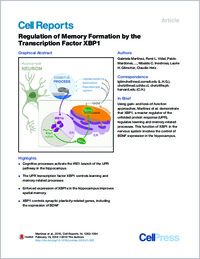
Contextual memory formation relies on the induction of new genes in the hippocampus. A polymorphism in the promoter of the transcription factor XBP1 was identified as a risk factor for Alzheimer's disease and bipolar disorders. XBP1 is a major regulator of the unfolded protein response (UPR), mediating adaptation to endoplasmic reticulum (ER) stress. Using a phenotypic screen, we uncovered an unexpected function of XBP1 in cognition and behavior. Mice lacking XBP1 in the nervous system showed specific impairment of contextual memory formation and long-term potentiation (LTP), whereas neuronal XBP1s overexpression improved performance in memory tasks. Gene expression analysis revealed that XBP1 regulates a group of memory-related genes, highlighting brain-derived neurotrophic factor (BDNF), a key component in memory consolidation. Overexpression of BDNF in the hippocampus reversed the XBP1-deficient phenotype. Our study revealed an unanticipated function of XBP1 in cognitive processes that is apparently unrelated to its role in ER stress.
- Language
-
- English
- Open access status
- gold
- Identifiers
-
- DOI 10.1016/j.celrep.2016.01.028
- PMID 26854229
- Persistent URL
- https://sonar.ch/global/documents/96967
Export to…
Statistics
Document views: 53
File downloads:
- Full-text: 0