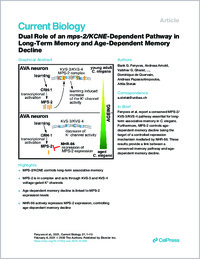
Dual Role of an mps-2/KCNE-Dependent Pathway in Long-Term Memory and Age-Dependent Memory Decline.
- Fenyves BG Transfaculty Research Platform Molecular and Cognitive Neurosciences, University of Basel, Birmannsgasse 8, 4055 Basel, Switzerland; Division of Molecular Neuroscience, Department of Psychology, University of Basel, Birmannsgasse 8, 4055 Basel, Switzerland; Department of Molecular Biology, Semmelweis University, Tűzoltó u. 37-47, 1094 Budapest, Hungary.
- Arnold A Transfaculty Research Platform Molecular and Cognitive Neurosciences, University of Basel, Birmannsgasse 8, 4055 Basel, Switzerland; Division of Molecular Neuroscience, Department of Psychology, University of Basel, Birmannsgasse 8, 4055 Basel, Switzerland.
- Gharat VG Transfaculty Research Platform Molecular and Cognitive Neurosciences, University of Basel, Birmannsgasse 8, 4055 Basel, Switzerland; Division of Molecular Neuroscience, Department of Psychology, University of Basel, Birmannsgasse 8, 4055 Basel, Switzerland.
- Haab C Division of Molecular Neuroscience, Department of Psychology, University of Basel, Birmannsgasse 8, 4055 Basel, Switzerland.
- Tishinov K Biozentrum, University of Basel, Klingelbergstrasse 50/70, 4056 Basel, Switzerland.
- Peter F Transfaculty Research Platform Molecular and Cognitive Neurosciences, University of Basel, Birmannsgasse 8, 4055 Basel, Switzerland; Division of Molecular Neuroscience, Department of Psychology, University of Basel, Birmannsgasse 8, 4055 Basel, Switzerland.
- de Quervain D Transfaculty Research Platform Molecular and Cognitive Neurosciences, University of Basel, Birmannsgasse 8, 4055 Basel, Switzerland; Division of Cognitive Neuroscience, Department of Psychology, University of Basel, Birmannsgasse 8, 4055 Basel, Switzerland; University Psychiatric Clinics, University of Basel, Wilhelm Klein-Strasse 27, 4055 Basel, Switzerland.
- Papassotiropoulos A Transfaculty Research Platform Molecular and Cognitive Neurosciences, University of Basel, Birmannsgasse 8, 4055 Basel, Switzerland; Division of Molecular Neuroscience, Department of Psychology, University of Basel, Birmannsgasse 8, 4055 Basel, Switzerland; Biozentrum, Life Sciences Training Facility, University of Basel, Klingelbergstrasse 50/70, 4056 Basel, Switzerland; University Psychiatric Clinics, University of Basel, Wilhelm Klein-Strasse 27, 4055 Basel, Switzerland.
- Stetak A Transfaculty Research Platform Molecular and Cognitive Neurosciences, University of Basel, Birmannsgasse 8, 4055 Basel, Switzerland; Division of Molecular Neuroscience, Department of Psychology, University of Basel, Birmannsgasse 8, 4055 Basel, Switzerland; University Psychiatric Clinics, University of Basel, Wilhelm Klein-Strasse 27, 4055 Basel, Switzerland. Electronic address: a.stetak@unibas.ch.
- 2020-12-01
Published in:
- Current biology : CB. - 2020
Caenorhabditis elegans
KCNE
ageing
kvs-3
kvs-4
long-term memory
mps-2
nhr-66
voltage-gated ion-channel
English
Activity-dependent persistent changes in neuronal intrinsic excitability and synaptic strength are underlying learning and memory. Voltage-gated potassium (Kv) channels are potential regulators of memory and may be linked to age-dependent neuronal disfunction. MinK-related peptides (MiRPs) are conserved transmembrane proteins modulating Kv channels; however, their possible role in the regulation of memory and age-dependent memory decline are unknown. Here, we show that, in C. elegans, mps-2 is the sole member of the MiRP family that controls exclusively long-term associative memory (LTAM) in AVA neuron. In addition, we demonstrate that mps-2 also plays a critical role in age-dependent memory decline. In young adult worms, mps-2 is transcriptionally upregulated by CRH-1/cyclic AMP (cAMP)-response-binding protein (CREB) during LTAM, although the mps-2 baseline expression is CREB independent and instead, during aging, relies on nhr-66, which acts as an age-dependent repressor. Deletion of nhr-66 or its binding element in the mps-2 promoter prevents age-dependent transcriptional repression of mps-2 and memory decline. Finally, MPS-2 acts through the modulation of the Kv2.1/KVS-3 and Kv2.2/KVS-4 heteromeric potassium channels. Altogether, we describe a conserved MPS-2/KVS-3/KVS-4 pathway essential for LTAM and also for a programmed control of physiological age-dependent memory decline.
- Language
-
- English
- Open access status
- hybrid
- Identifiers
-
- DOI 10.1016/j.cub.2020.10.069
- PMID 33259792
- Persistent URL
- https://sonar.ch/global/documents/98796
Export to…
Statistics
Document views: 42
File downloads:
- Full-text: 0