Compensation of Signal Spillover in Suspension and Imaging Mass Cytometry.
- Chevrier S Institute of Molecular Life Sciences, University of Zurich, Zurich, Switzerland.
- Crowell HL Institute of Molecular Life Sciences, University of Zurich, Zurich, Switzerland; SIB Swiss Institute of Bioinformatics, University of Zurich, Zurich, Switzerland.
- Zanotelli VRT Institute of Molecular Life Sciences, University of Zurich, Zurich, Switzerland; Systems Biology Ph.D. Program, Life Science Zürich Graduate School, ETH Zürich and University of Zürich, Zürich, Switzerland.
- Engler S Institute of Molecular Life Sciences, University of Zurich, Zurich, Switzerland.
- Robinson MD Institute of Molecular Life Sciences, University of Zurich, Zurich, Switzerland; SIB Swiss Institute of Bioinformatics, University of Zurich, Zurich, Switzerland. Electronic address: mark.robinson@imls.uzh.ch.
- Bodenmiller B Institute of Molecular Life Sciences, University of Zurich, Zurich, Switzerland. Electronic address: bernd.bodenmiller@imls.uzh.ch.
- 2018-04-02
Published in:
- Cell systems. - 2018
CyTOF
channel interference
compensation
imaging mass cytometry
mass cytometry
signal crosstalk
spillover
Antibodies
Breast Neoplasms
Female
Flow Cytometry
Humans
Image Cytometry
Immunophenotyping
Reproducibility of Results
Signal-To-Noise Ratio
Single-Cell Analysis
Software
Suspensions
English
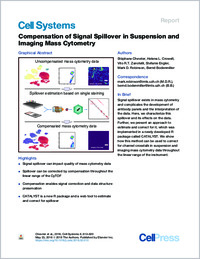
The advent of mass cytometry increased the number of parameters measured at the single-cell level while decreasing the extent of crosstalk between channels relative to dye-based flow cytometry. Although reduced, spillover still exists in mass cytometry data, and minimizing its effect requires considerable expert knowledge and substantial experimental effort. Here, we describe a novel bead-based compensation workflow and R-based software that estimates and corrects for interference between channels. We performed an in-depth characterization of the spillover properties in mass cytometry, including limitations defined by the linear range of the mass cytometer and the reproducibility of the spillover over time and across machines. We demonstrated the utility of our method in suspension and imaging mass cytometry. To conclude, our approach greatly simplifies the development of new antibody panels, increases flexibility for antibody-metal pairing, opens the way to using less pure isotopes, and improves overall data quality, thereby reducing the risk of reporting cell phenotype artifacts.
- Language
-
- English
- Open access status
- hybrid
- Identifiers
-
- DOI 10.1016/j.cels.2018.02.010
- PMID 29605184
- Persistent URL
- https://sonar.ch/global/documents/99094
Export to…
Statistics
Document views: 88
File downloads:
- Full-text: 0