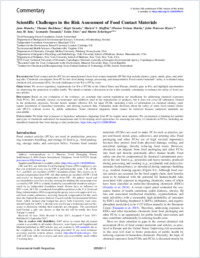
Scientific Challenges in the Risk Assessment of Food Contact Materials.
- Muncke J Food Packaging Forum Foundation , Zurich, Switzerland.
- Backhaus T Department of Biological & Environmental Sciences, University of Gothenburg , Sweden.
- Geueke B Food Packaging Forum Foundation , Zurich, Switzerland.
- Maffini MV Independent Consultant, Germantown, Maryland, USA.
- Martin OV Institute for the Environment, Brunel University London , Uxbridge, UK.
- Myers JP Environmental Health Sciences , Charlottesville, Virginia, USA.
- Soto AM Department of Integrative Physiology and Pathobiology, Tufts University School of Medicine , Boston, Massachusetts, USA.
- Trasande L Department of Pediatrics, New York University School of Medicine , New York, New York, USA.
- Trier X DTU Food, Technical University of Denmark , Copenhagen, Denmark (currently at European Environmental Agency, Copenhagen, Denmark ).
- Scheringer M Research Centre for Toxic Compounds in the Environment, Masaryk University , Brno, Czech Republic.
- 2017-09-13
Published in:
- Environmental health perspectives. - 2017
Europe
Food Contamination
Food Packaging
Food Safety
Hazardous Substances
Humans
Plastics
Public Health
Risk Assessment
United States
English
BACKGROUND
Food contact articles (FCAs) are manufactured from food contact materials (FCMs) that include plastics, paper, metal, glass, and printing inks. Chemicals can migrate from FCAs into food during storage, processing, and transportation. Food contact materials' safety is evaluated using chemical risk assessment (RA). Several challenges to the RA of FCAs exist.
OBJECTIVES
We review regulatory requirements for RA of FCMs in the United States and Europe, identify gaps in RA, and highlight opportunities for improving the protection of public health. We intend to initiate a discussion in the wider scientific community to enhance the safety of food contact articles.
DISCUSSION
Based on our evaluation of the evidence, we conclude that current regulations are insufficient for addressing chemical exposures from FCAs. RA currently focuses on monomers and additives used in the manufacture of products, but it does not cover all substances formed in the production processes. Several factors hamper effective RA for many FCMs, including a lack of information on chemical identity, inadequate assessment of hazardous properties, and missing exposure data. Companies make decisions about the safety of some food contact chemicals (FCCs) without review by public authorities. Some chemical migration limits cannot be enforced because analytical standards are unavailable.
CONCLUSION
We think that exposures to hazardous substances migrating from FCAs require more attention. We recommend a) limiting the number and types of chemicals authorized for manufacture and b) developing novel approaches for assessing the safety of chemicals in FCAs, including unidentified chemicals that form during or after production. https://doi.org/10.1289/EHP644.
Food contact articles (FCAs) are manufactured from food contact materials (FCMs) that include plastics, paper, metal, glass, and printing inks. Chemicals can migrate from FCAs into food during storage, processing, and transportation. Food contact materials' safety is evaluated using chemical risk assessment (RA). Several challenges to the RA of FCAs exist.
OBJECTIVES
We review regulatory requirements for RA of FCMs in the United States and Europe, identify gaps in RA, and highlight opportunities for improving the protection of public health. We intend to initiate a discussion in the wider scientific community to enhance the safety of food contact articles.
DISCUSSION
Based on our evaluation of the evidence, we conclude that current regulations are insufficient for addressing chemical exposures from FCAs. RA currently focuses on monomers and additives used in the manufacture of products, but it does not cover all substances formed in the production processes. Several factors hamper effective RA for many FCMs, including a lack of information on chemical identity, inadequate assessment of hazardous properties, and missing exposure data. Companies make decisions about the safety of some food contact chemicals (FCCs) without review by public authorities. Some chemical migration limits cannot be enforced because analytical standards are unavailable.
CONCLUSION
We think that exposures to hazardous substances migrating from FCAs require more attention. We recommend a) limiting the number and types of chemicals authorized for manufacture and b) developing novel approaches for assessing the safety of chemicals in FCAs, including unidentified chemicals that form during or after production. https://doi.org/10.1289/EHP644.
- Language
-
- English
- Open access status
- gold
- Identifiers
-
- DOI 10.1289/EHP644
- PMID 28893723
- Persistent URL
- https://sonar.ch/global/documents/120216
Statistics
Document views: 109
File downloads:
- Full-text: 0