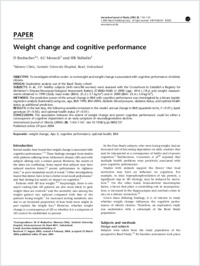
Weight change and cognitive performance.
- Brubacher D Memory Clinic, Geriatric University Hospital, Basel, Switzerland. dorothee.brubacher@unibas.ch
- Monsch AU
- Stähelin HB
- 2004-06-30
Published in:
- International journal of obesity and related metabolic disorders : journal of the International Association for the Study of Obesity. - 2004
Aged
Apolipoproteins E
Body Mass Index
Body Weight
Cognition Disorders
Female
Follow-Up Studies
Genetic Predisposition to Disease
Genotype
Humans
Logistic Models
Male
Middle Aged
Neuropsychological Tests
Weight Gain
Weight Loss
English
OBJECTIVE
To investigate whether under- or overweight and weight change is associated with cognitive performance of elderly citizens.
DESIGN
Explorative analysis out of the Basel Study cohort.
SUBJECTS
In all, 531 healthy subjects (445 men/86 women) were assessed with the Consortium to Establish a Registry for Alzheimer's Disease-Neuropsychological Assessment Battery (CERAD-NAB) in 2000 (age: 69.4+/-7.8 y) and weight measurements obtained in 1990 (body mass index (BMI): 25.2+/-3.1 kg/m(2)) and in 2000 (BMI: 25.6+/-3.4 kg/m(2)).
METHODS
The predictive power of the annual change in BMI with cognitive performance was investigated by a binary logistic regression analysis (backward) using sex, age, BMI 1990, BMI 2000, diastolic blood pressure, diabetes status, and optimal health status as additional predictors.
RESULTS
In the last step, the following variables remained in the model: annual change in BMI (quadratic term; P<0.01); ApoE genotype (P<0.05); and optimal health status (P<0.01).
CONCLUSION
The association between the extent of weight change and poorer cognitive performance could be either a consequence of cognitive impairment or an early symptom of neurodegenerative decline.
To investigate whether under- or overweight and weight change is associated with cognitive performance of elderly citizens.
DESIGN
Explorative analysis out of the Basel Study cohort.
SUBJECTS
In all, 531 healthy subjects (445 men/86 women) were assessed with the Consortium to Establish a Registry for Alzheimer's Disease-Neuropsychological Assessment Battery (CERAD-NAB) in 2000 (age: 69.4+/-7.8 y) and weight measurements obtained in 1990 (body mass index (BMI): 25.2+/-3.1 kg/m(2)) and in 2000 (BMI: 25.6+/-3.4 kg/m(2)).
METHODS
The predictive power of the annual change in BMI with cognitive performance was investigated by a binary logistic regression analysis (backward) using sex, age, BMI 1990, BMI 2000, diastolic blood pressure, diabetes status, and optimal health status as additional predictors.
RESULTS
In the last step, the following variables remained in the model: annual change in BMI (quadratic term; P<0.01); ApoE genotype (P<0.05); and optimal health status (P<0.01).
CONCLUSION
The association between the extent of weight change and poorer cognitive performance could be either a consequence of cognitive impairment or an early symptom of neurodegenerative decline.
- Language
-
- English
- Open access status
- bronze
- Identifiers
-
- DOI 10.1038/sj.ijo.0802721
- PMID 15224124
- Persistent URL
- https://sonar.ch/global/documents/198247
Export to…
Statistics
Document views: 47
File downloads:
- Full-text: 0