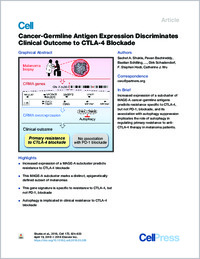
Cancer-Germline Antigen Expression Discriminates Clinical Outcome to CTLA-4 Blockade.
- Shukla SA Department of Medical Oncology, Dana-Farber Cancer Institute, Harvard Medical School, Boston, MA 02215, USA; Broad Institute, Cambridge, MA 02142, USA.
- Bachireddy P Department of Medical Oncology, Dana-Farber Cancer Institute, Harvard Medical School, Boston, MA 02215, USA; Broad Institute, Cambridge, MA 02142, USA; Department of Medicine, Brigham & Women's Hospital, Boston, MA 02115, USA.
- Schilling B Department of Dermatology, University Hospital, University Duisburg-Essen, 45147 Essen, Germany; German Cancer Consortium (DKTK), 69121 Heidelberg, Germany; Department of Dermatology, Venereology and Allergology, University Hospital Würzburg, 97080 Würzburg, Germany.
- Galonska C Max Planck Institute for Molecular Genetics, 14195 Berlin, Germany.
- Zhan Q Program in Dermatopathology, Department of Pathology, Brigham and Women's Hospital, Harvard Medical School, Boston, MA 02115, USA.
- Bango C Department of Medical Oncology, Dana-Farber Cancer Institute, Harvard Medical School, Boston, MA 02215, USA.
- Langer R Department of Pathology, University of Bern, 3012 Bern, Switzerland.
- Lee PC Department of Medical Oncology, Dana-Farber Cancer Institute, Harvard Medical School, Boston, MA 02215, USA.
- Gusenleitner D Department of Medical Oncology, Dana-Farber Cancer Institute, Harvard Medical School, Boston, MA 02215, USA.
- Keskin DB Department of Medical Oncology, Dana-Farber Cancer Institute, Harvard Medical School, Boston, MA 02215, USA; Broad Institute, Cambridge, MA 02142, USA; Department of Medicine, Brigham & Women's Hospital, Boston, MA 02115, USA.
- Babadi M Broad Institute, Cambridge, MA 02142, USA.
- Mohammad A Broad Institute, Cambridge, MA 02142, USA.
- Gnirke A Broad Institute, Cambridge, MA 02142, USA.
- Clement K Broad Institute, Cambridge, MA 02142, USA; Department of Stem Cell and Regenerative Biology, Harvard University, Cambridge, MA 02138, USA.
- Cartun ZJ Department of Medical Oncology, Dana-Farber Cancer Institute, Harvard Medical School, Boston, MA 02215, USA.
- Van Allen EM Department of Medical Oncology, Dana-Farber Cancer Institute, Harvard Medical School, Boston, MA 02215, USA; Broad Institute, Cambridge, MA 02142, USA; Department of Medicine, Brigham & Women's Hospital, Boston, MA 02115, USA.
- Miao D Department of Medical Oncology, Dana-Farber Cancer Institute, Harvard Medical School, Boston, MA 02215, USA; Broad Institute, Cambridge, MA 02142, USA.
- Huang Y Department of Medical Oncology, Dana-Farber Cancer Institute, Harvard Medical School, Boston, MA 02215, USA.
- Snyder A Weill Cornell Medical College, New York, NY, USA; Department of Medicine, Memorial Sloan Kettering Cancer Center, New York, NY 10016, USA.
- Merghoub T Weill Cornell Medical College, New York, NY, USA; Department of Medicine, Memorial Sloan Kettering Cancer Center, New York, NY 10016, USA.
- Wolchok JD Weill Cornell Medical College, New York, NY, USA; Department of Medicine, Memorial Sloan Kettering Cancer Center, New York, NY 10016, USA.
- Garraway LA Department of Medical Oncology, Dana-Farber Cancer Institute, Harvard Medical School, Boston, MA 02215, USA; Broad Institute, Cambridge, MA 02142, USA; Department of Medicine, Brigham & Women's Hospital, Boston, MA 02115, USA.
- Meissner A Broad Institute, Cambridge, MA 02142, USA; Max Planck Institute for Molecular Genetics, 14195 Berlin, Germany; Department of Stem Cell and Regenerative Biology, Harvard University, Cambridge, MA 02138, USA.
- Weber JS New York University Langone Medical Center, New York, NY 10016, USA.
- Hacohen N Broad Institute, Cambridge, MA 02142, USA.
- Neuberg D Department of Biostatistics and Computational Biology, Dana-Farber Cancer Institute, Boston, MA 02115, USA.
- Potts PR Department of Cell and Molecular Biology, St. Jude Children's Research Hospital, Memphis, TN 38105-3678, USA.
- Murphy GF Program in Dermatopathology, Department of Pathology, Brigham and Women's Hospital, Harvard Medical School, Boston, MA 02115, USA.
- Lian CG Program in Dermatopathology, Department of Pathology, Brigham and Women's Hospital, Harvard Medical School, Boston, MA 02115, USA.
- Schadendorf D Department of Dermatology, University Hospital, University Duisburg-Essen, 45147 Essen, Germany; German Cancer Consortium (DKTK), 69121 Heidelberg, Germany.
- Hodi FS Department of Medical Oncology, Dana-Farber Cancer Institute, Harvard Medical School, Boston, MA 02215, USA; Department of Medicine, Brigham & Women's Hospital, Boston, MA 02115, USA.
- Wu CJ Department of Medical Oncology, Dana-Farber Cancer Institute, Harvard Medical School, Boston, MA 02215, USA; Broad Institute, Cambridge, MA 02142, USA; Department of Medicine, Brigham & Women's Hospital, Boston, MA 02115, USA. Electronic address: cwu@partners.org.
- 2018-04-17
Published in:
- Cell. - 2018
CTLA-4
MAGE-A
PD-1
autophagy
cancer-germline antigen
checkpoint blockade
immunogenomics
immunotherapy
ipilimumab
melanoma
Animals
Antibodies, Monoclonal
Antigens, Neoplasm
Autophagy
CTLA-4 Antigen
Cell Line, Tumor
DNA Methylation
Epigenesis, Genetic
Female
Gene Expression Profiling
Germ-Line Mutation
Humans
Immunotherapy
Ipilimumab
Male
Melanoma
Melanoma-Specific Antigens
Mice
Mice, Transgenic
Neoplasms
Skin Neoplasms
English
CTLA-4 immune checkpoint blockade is clinically effective in a subset of patients with metastatic melanoma. We identify a subcluster of MAGE-A cancer-germline antigens, located within a narrow 75 kb region of chromosome Xq28, that predicts resistance uniquely to blockade of CTLA-4, but not PD-1. We validate this gene expression signature in an independent anti-CTLA-4-treated cohort and show its specificity to the CTLA-4 pathway with two independent anti-PD-1-treated cohorts. Autophagy, a process critical for optimal anti-cancer immunity, has previously been shown to be suppressed by the MAGE-TRIM28 ubiquitin ligase in vitro. We now show that the expression of the key autophagosome component LC3B and other activators of autophagy are negatively associated with MAGE-A protein levels in human melanomas, including samples from patients with resistance to CTLA-4 blockade. Our findings implicate autophagy suppression in resistance to CTLA-4 blockade in melanoma, suggesting exploitation of autophagy induction for potential therapeutic synergy with CTLA-4 inhibitors.
- Language
-
- English
- Open access status
- bronze
- Identifiers
-
- DOI 10.1016/j.cell.2018.03.026
- PMID 29656892
- Persistent URL
- https://sonar.ch/global/documents/222791
Export to…
Statistics
Document views: 125
File downloads:
- Full-text: 0