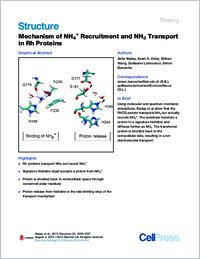
Mechanism of NH4(+) Recruitment and NH3 Transport in Rh Proteins.
- Baday S SIB Swiss Institute of Bioinformatics, Klingelbergstrasse 50/70, 4056 Basel, Switzerland; Biozentrum, University of Basel, Klingelbergstrasse 50/70, 4056 Basel, Switzerland.
- Orabi EA Department of Chemistry and Biochemistry, Centre for Research in Molecular Modeling (CERMM), Concordia University, 7141 Sherbrooke Street West, Montréal, QC H4B 1R6, Canada.
- Wang S Department of Chemistry and Biochemistry, Centre for Research in Molecular Modeling (CERMM), Concordia University, 7141 Sherbrooke Street West, Montréal, QC H4B 1R6, Canada.
- Lamoureux G Department of Chemistry and Biochemistry, Centre for Research in Molecular Modeling (CERMM), Concordia University, 7141 Sherbrooke Street West, Montréal, QC H4B 1R6, Canada. Electronic address: guillaume.lamoureux@concordia.ca.
- Bernèche S SIB Swiss Institute of Bioinformatics, Klingelbergstrasse 50/70, 4056 Basel, Switzerland; Biozentrum, University of Basel, Klingelbergstrasse 50/70, 4056 Basel, Switzerland. Electronic address: simon.berneche@isb-sib.ch.
- 2015-07-21
Published in:
- Structure (London, England : 1993). - 2015
Ammonia
Aspartic Acid
Cation Transport Proteins
Cell Membrane
Dimyristoylphosphatidylcholine
Histidine
Humans
Hydrogen Bonding
Hydrogen-Ion Concentration
Ion Transport
Kinetics
Membrane Glycoproteins
Molecular Dynamics Simulation
Protein Multimerization
Protons
Quantum Theory
Static Electricity
Thermodynamics
English
In human cells, membrane proteins of the rhesus (Rh) family excrete ammonium and play a role in pH regulation. Based on high-resolution structures, Rh proteins are generally understood to act as NH3 channels. Given that cell membranes are permeable to gases like NH3, the role of such proteins remains a paradox. Using molecular and quantum mechanical calculations, we show that a crystallographically identified site in the RhCG pore actually recruits NH4(+), which is found in higher concentration and binds with higher affinity than NH3, increasing the efficiency of the transport mechanism. A proton is transferred from NH4(+) to a signature histidine (the only moiety thermodynamically likely to accept a proton) followed by the diffusion of NH3 down the pore. The excess proton is circulated back to the extracellular vestibule through a hydrogen bond network, which involves a highly conserved and functionally important aspartic acid, resulting in the net transport of NH3.
- Language
-
- English
- Open access status
- bronze
- Identifiers
-
- DOI 10.1016/j.str.2015.06.010
- PMID 26190573
- Persistent URL
- https://sonar.ch/global/documents/232237
Statistics
Document views: 48
File downloads:
- Full-text: 0