A Dioxobilin-Type Fluorescent Chlorophyll Catabolite as a Transient Early Intermediate of the Dioxobilin-Branch of Chlorophyll Breakdown in Arabidopsis thaliana.
- Süssenbacher I Institut für Organische Chemie und Centrum für Molekulare Biowissenschaften, Universität Innsbruck, Innrain 80/82, 6020 Innsbruck (Austria).
- Hörtensteiner S Institut für Pflanzenbiologie, Universität Zürich, Zollikerstrasse 107, 8008 Zürich (Switzerland).
- Kräutler B Institut für Organische Chemie und Centrum für Molekulare Biowissenschaften, Universität Innsbruck, Innrain 80/82, 6020 Innsbruck (Austria). bernhard.kraeutler@uibk.ac.at.
- 2015-10-02
Published in:
- Angewandte Chemie (International ed. in English). - 2015
chlorophylls
isomerization
phyllobilin
structure elucidation
tetrapyrrole
Arabidopsis
Chlorophyll
Fluorescent Dyes
Molecular Conformation
Plant Leaves
Tetrapyrroles
English
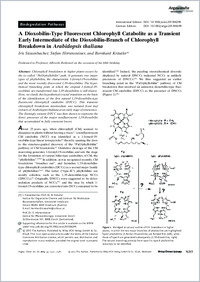
Chlorophyll breakdown in higher plants occurs by the so called "PaO/phyllobilin" path. It generates two major types of phyllobilins, the characteristic 1-formyl-19-oxobilins and the more recently discovered 1,19-dioxobilins. The hypothetical branching point at which the original 1-formyl-19-oxobilins are transformed into 1,19-dioxobilins is still elusive. Here, we clarify this hypothetical crucial transition on the basis of the identification of the first natural 1,19-dioxobilin-type fluorescent chlorophyll catabolite (DFCC). This transient chlorophyll breakdown intermediate was isolated from leaf extracts of Arabidopsis thaliana at an early stage of senescence. The fleetingly existent DFCC was then shown to represent the direct precursor of the major nonfluorescent 1,19-dioxobilin that accumulated in fully senescent leaves.
- Language
-
- English
- Open access status
- green
- Identifiers
-
- DOI 10.1002/anie.201506299
- PMID 26426977
- Persistent URL
- https://sonar.ch/global/documents/263442
Statistics
Document views: 33
File downloads:
- Full-text: 0