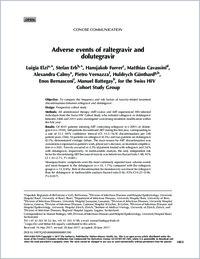
Adverse events of raltegravir and dolutegravir.
- Elzi L aOspedale Regionale di Bellinzone e Valli, Bellinzona bDivision of Infectious Diseases and Hospital Epidemiology, University Hospital Basel, University of Basel, Basel cDepartment of Infectious Diseases, University Hospital Bern, University of Bern dDivision of Infectious Diseases, University Hospital Lausanne, Lausanne eDivision of Infectious Diseases, University Hospital Geneva, Geneva fDivision of Infectious Diseases, Cantonal Hospital St Gallen, St Gallen gDivision of Infectious Diseases and Hospital Epidemiology, University Hospital Zürich, Zürich hInstitute of Medical Virology, University of Zürich, Zürich iDivision of Infectious Diseases, Regional Hospital Lugano, Lugano, Switzerland. *Luigia Elzi and Stefan Erb equally contributed to this article.
- Erb S
- Furrer H
- Cavassini M
- Calmy A
- Vernazza P
- Günthard H
- Bernasconi E
- Battegay M
- 2017-07-11
Published in:
- AIDS (London, England). - 2017
Adolescent
Adult
Aged
Aged, 80 and over
Anti-HIV Agents
Drug-Related Side Effects and Adverse Reactions
Female
HIV Infections
Heterocyclic Compounds, 3-Ring
Humans
Male
Mental Disorders
Middle Aged
Prospective Studies
Raltegravir Potassium
Switzerland
Withholding Treatment
Young Adult
English
OBJECTIVE
To compare the frequency and risk factors of toxicity-related treatment discontinuations between raltegravir and dolutegravir.
DESIGN
Prospective cohort study.
METHODS
All antiretroviral therapy (ART)-naïve and ART-experienced HIV-infected individuals from the Swiss HIV Cohort Study who initiated raltegravir or dolutegravir between 2006 and 2015 were investigated concerning treatment modification within the first year.
RESULTS
Of 4041 patients initiating ART containing raltegravir (n = 2091) or dolutegravir (n = 1950), 568 patients discontinued ART during the first year, corresponding to a rate of 15.5 [95% confidence interval (CI) 14.5-16.9] discontinuations per 100 patient-years. Only 10 patients on raltegravir (0.5%) and two patients on dolutegravir (0.1%) demonstrated virologic failure. The main reason for ART discontinuation was convenience expressed as patient's wish, physician's decision, or treatment simplification (n = 302). Toxicity occurred in 4.3% of patients treated with raltegravir and 3.6% with dolutegravir, respectively. In multivariable analysis, the only independent risk factor for discontinuing ART because of toxicity was female sex (hazard ratio 1.98, 95% CI 1.45-2.71, P < 0.001).Neuropsychiatric complaints were the most commonly reported toxic adverse events and more frequent in the dolutegravir (n = 33, 1.7%) compared with the raltegravir group (n = 13, 0.6%). Risk of discontinuation for neurotoxicity was lower for raltegravir than for dolutegravir in multivariable analysis (hazard ratio 0.46, 95% CI 0.22-0.96, P = 0.037).
CONCLUSION
In this, large cohort raltegravir and dolutegravir-containing regimen demonstrated a high virologic efficacy. Drug toxicity was infrequent and discontinuation because of neuropsychiatric events within the first year of treatment was only marginal higher with dolutegravir compared with raltegravir. However, monitoring of neurotoxic side-effects of dolutegravir is important.
To compare the frequency and risk factors of toxicity-related treatment discontinuations between raltegravir and dolutegravir.
DESIGN
Prospective cohort study.
METHODS
All antiretroviral therapy (ART)-naïve and ART-experienced HIV-infected individuals from the Swiss HIV Cohort Study who initiated raltegravir or dolutegravir between 2006 and 2015 were investigated concerning treatment modification within the first year.
RESULTS
Of 4041 patients initiating ART containing raltegravir (n = 2091) or dolutegravir (n = 1950), 568 patients discontinued ART during the first year, corresponding to a rate of 15.5 [95% confidence interval (CI) 14.5-16.9] discontinuations per 100 patient-years. Only 10 patients on raltegravir (0.5%) and two patients on dolutegravir (0.1%) demonstrated virologic failure. The main reason for ART discontinuation was convenience expressed as patient's wish, physician's decision, or treatment simplification (n = 302). Toxicity occurred in 4.3% of patients treated with raltegravir and 3.6% with dolutegravir, respectively. In multivariable analysis, the only independent risk factor for discontinuing ART because of toxicity was female sex (hazard ratio 1.98, 95% CI 1.45-2.71, P < 0.001).Neuropsychiatric complaints were the most commonly reported toxic adverse events and more frequent in the dolutegravir (n = 33, 1.7%) compared with the raltegravir group (n = 13, 0.6%). Risk of discontinuation for neurotoxicity was lower for raltegravir than for dolutegravir in multivariable analysis (hazard ratio 0.46, 95% CI 0.22-0.96, P = 0.037).
CONCLUSION
In this, large cohort raltegravir and dolutegravir-containing regimen demonstrated a high virologic efficacy. Drug toxicity was infrequent and discontinuation because of neuropsychiatric events within the first year of treatment was only marginal higher with dolutegravir compared with raltegravir. However, monitoring of neurotoxic side-effects of dolutegravir is important.
- Language
-
- English
- Open access status
- green
- Identifiers
-
- DOI 10.1097/QAD.0000000000001590
- PMID 28692533
- Persistent URL
- https://sonar.ch/global/documents/278547
Export to…
Statistics
Document views: 52
File downloads:
- Full-text: 0