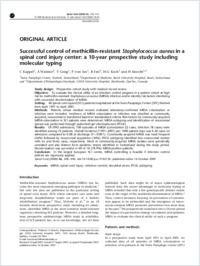
Successful control of methicillin-resistant Staphylococcus aureus in a spinal cord injury center: a 10-year prospective study including molecular typing.
- Kappel C Swiss Paraplegic Centre, Nottwil, Switzerland.
- Widmer A
- Geng V
- von Arx P
- Frei R
- Koch HG
- Knecht H
- 2007-10-17
Published in:
- Spinal cord. - 2008
Adolescent
Adult
Aged
Aged, 80 and over
Canada
Cohort Studies
Cross Infection
Female
Hospitals, University
Humans
Infection Control
Male
Methicillin Resistance
Middle Aged
Molecular Epidemiology
Retrospective Studies
Risk Factors
Spinal Cord Injuries
Staphylococcal Infections
English
STUDY DESIGN
Prospective cohort study with medical record review.
OBJECTIVE
To evaluate the clinical utility of an infection control program in a patient cohort at high risk for methicillin-resistant Staphylococcus aureus (MRSA) infection and to identify risk factors interfering with successful decolonization of MRSA.
SETTING
All spinal cord injured (SCI) patients hospitalized at the Swiss Paraplegic Center (SPC) Nottwil from April 1991 to April 2001.
METHODS
Patients whose medical records indicated laboratory-confirmed MRSA colonization or infection were included. Incidence of MRSA colonization or infection was classified as community acquired, nosocomial or transferred based on standardized criteria. Risk factors for community-acquired MRSA colonization in SCI patients were determined. MRSA subtyping and identification of nosocomial spread was performed through pulse-field gel electrophoresis (PFGE).
RESULTS
Of 5992 admissions, 100 episodes of MRSA (colonization 22 cases, infection 78 cases) were identified among 76 patients. Overall incidence (1991-2001) per 1000 patient days was 0.26 cases on admission compared to 0.08 at discharge (P<0.001). Community-acquired MRSA was most frequent (56%) followed by nosocomial acquisition (34%). PFGE subtyping identified two nosocomial clusters with six and three cases, respectively. Most of community-acquired MRSA isolates were genetically unrelated and also distinct from epidemic strains identified in Switzerland during the study period. Decolonization was successful in 60 of 76 (78.9%) MRSA-positive patients.
CONCLUSION
In the largest European SCI center, MRSA controlling is feasible if infection control policies are vigorously applied.
Prospective cohort study with medical record review.
OBJECTIVE
To evaluate the clinical utility of an infection control program in a patient cohort at high risk for methicillin-resistant Staphylococcus aureus (MRSA) infection and to identify risk factors interfering with successful decolonization of MRSA.
SETTING
All spinal cord injured (SCI) patients hospitalized at the Swiss Paraplegic Center (SPC) Nottwil from April 1991 to April 2001.
METHODS
Patients whose medical records indicated laboratory-confirmed MRSA colonization or infection were included. Incidence of MRSA colonization or infection was classified as community acquired, nosocomial or transferred based on standardized criteria. Risk factors for community-acquired MRSA colonization in SCI patients were determined. MRSA subtyping and identification of nosocomial spread was performed through pulse-field gel electrophoresis (PFGE).
RESULTS
Of 5992 admissions, 100 episodes of MRSA (colonization 22 cases, infection 78 cases) were identified among 76 patients. Overall incidence (1991-2001) per 1000 patient days was 0.26 cases on admission compared to 0.08 at discharge (P<0.001). Community-acquired MRSA was most frequent (56%) followed by nosocomial acquisition (34%). PFGE subtyping identified two nosocomial clusters with six and three cases, respectively. Most of community-acquired MRSA isolates were genetically unrelated and also distinct from epidemic strains identified in Switzerland during the study period. Decolonization was successful in 60 of 76 (78.9%) MRSA-positive patients.
CONCLUSION
In the largest European SCI center, MRSA controlling is feasible if infection control policies are vigorously applied.
- Language
-
- English
- Open access status
- bronze
- Identifiers
-
- DOI 10.1038/sj.sc.3102135
- PMID 17938641
- Persistent URL
- https://sonar.ch/global/documents/278795
Statistics
Document views: 42
File downloads:
- Full-text: 0