The pivotal sign of CANVAS.
- Petersen JA From the Departments of Neurology (J.A.P., K.P.W.), Neuroradiology (W.W.W.), and Ophthalmology (K.P.W.), University Hospital Zurich, Switzerland.
- Wichmann WW
- Weber KP
- 2013-10-30
Published in:
- Neurology. - 2013
Aged
Cerebellar Ataxia
Female
Humans
Magnetic Resonance Imaging
Reflex, Vestibulo-Ocular
Vestibular Diseases
English
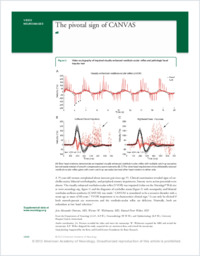
A 75-year-old woman complained about insecure gait since age 55. Clinical examination revealed signs of cerebellar ataxia, bilateral vestibulopathy, and peripheral sensory impairment. Sensory nerve action potentials were absent. The visually enhanced vestibulo-ocular reflex (VVOR) was impaired (video on the Neurology(®) Web site at www.neurology.org, figure 1) and the diagnosis of cerebellar ataxia (figure 2) with neuropathy and bilateral vestibular areflexia syndrome (CANVAS) was made.(1) CANVAS is considered to be a recessive disorder with a mean age at onset of 60 years.(2) VVOR impairment is its characteristic clinical sign.(2) It can only be elicited if both smooth-pursuit eye movements and the vestibulo-ocular reflex are deficient. Normally, both are redundant at low head velocities.(2.)
- Language
-
- English
- Open access status
- bronze
- Identifiers
-
- DOI 10.1212/WNL.0b013e3182a9f435
- PMID 24166963
- Persistent URL
- https://sonar.ch/global/documents/287155
Statistics
Document views: 35
File downloads:
- Full-text: 0