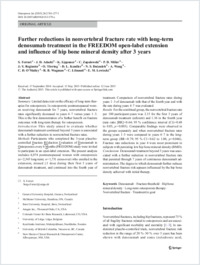
Further reductions in nonvertebral fracture rate with long-term denosumab treatment in the FREEDOM open-label extension and influence of hip bone mineral density after 3 years.
- Ferrari S Geneva University Hospital, Geneva, Switzerland. Serge.Ferrari@unige.ch.
- Adachi JD McMaster University, Hamilton, ON, Canada.
- Lippuner K Bern University Hospital, Bern, Switzerland.
- Zapalowski C Amgen Inc., Thousand Oaks, CA, USA.
- Miller PD Colorado Center for Bone Research, Lakewood, CO, USA.
- Reginster JY University of Liège, Liège, Belgium.
- Törring O Karolinska Institutet, Södersjukhuset, Stockholm, Sweden.
- Kendler DL University of British Columbia, Vancouver, BC, Canada.
- Daizadeh NS Amgen Inc., Thousand Oaks, CA, USA.
- Wang A Amgen Inc., Thousand Oaks, CA, USA.
- O'Malley CD Amgen Inc., Thousand Oaks, CA, USA.
- Wagman RB Amgen Inc., Thousand Oaks, CA, USA.
- Libanati C Amgen Inc., Thousand Oaks, CA, USA.
- Lewiecki EM New Mexico Clinical Research & Osteoporosis Center, Albuquerque, NM, USA.
- 2015-06-13
Published in:
- Osteoporosis international : a journal established as result of cooperation between the European Foundation for Osteoporosis and the National Osteoporosis Foundation of the USA. - 2015
Denosumab
Fracture threshold
Hip bone mineral density
Long-term osteoporosis therapy
Nonvertebral fracture
Treatment to goal
Aged
Aged, 80 and over
Bone Density
Bone Density Conservation Agents
Denosumab
Double-Blind Method
Drug Administration Schedule
Female
Follow-Up Studies
Hip Joint
Humans
Incidence
Middle Aged
Osteoporosis, Postmenopausal
Osteoporotic Fractures
English
UNLABELLED
Limited data exist on the efficacy of long-term therapies for osteoporosis. In osteoporotic postmenopausal women receiving denosumab for 7 years, nonvertebral fracture rates significantly decreased in years 4-7 versus years 1-3. This is the first demonstration of a further benefit on fracture outcomes with long-term therapy for osteoporosis.
INTRODUCTION
This study aimed to evaluate whether denosumab treatment continued beyond 3 years is associated with a further reduction in nonvertebral fracture rates.
METHODS
Participants who completed the 3-year placebo-controlled Fracture REduction Evaluation of Denosumab in Osteoporosis every 6 Months (FREEDOM) study were invited to participate in an open-label extension. The present analysis includes 4,074 postmenopausal women with osteoporosis (n = 2,343 long-term; n = 1,731 cross-over) who enrolled in the extension, missed ≤1 dose during their first 3 years of denosumab treatment, and continued into the fourth year of treatment. Comparison of nonvertebral fracture rates during years 1-3 of denosumab with that of the fourth year and with the rate during years 4-7 was evaluated.
RESULTS
For the combined group, the nonvertebral fracture rate per 100 participant-years was 2.15 for the first 3 years of denosumab treatment (referent) and 1.36 in the fourth year (rate ratio [RR] = 0.64; 95 % confidence interval (CI) = 0.48 to 0.85, p = 0.003). Comparable findings were observed in the groups separately and when nonvertebral fracture rates during years 1-3 were compared to years 4-7 in the long-term group (RR = 0.79; 95 % CI = 0.62 to 1.00, p = 0.046). Fracture rate reductions in year 4 were most prominent in subjects with persisting low hip bone mineral density (BMD).
CONCLUSIONS
Denosumab treatment beyond 3 years was associated with a further reduction in nonvertebral fracture rate that persisted through 7 years of continuous denosumab administration. The degree to which denosumab further reduces nonvertebral fracture risk appears influenced by the hip bone density achieved with initial therapy.
Limited data exist on the efficacy of long-term therapies for osteoporosis. In osteoporotic postmenopausal women receiving denosumab for 7 years, nonvertebral fracture rates significantly decreased in years 4-7 versus years 1-3. This is the first demonstration of a further benefit on fracture outcomes with long-term therapy for osteoporosis.
INTRODUCTION
This study aimed to evaluate whether denosumab treatment continued beyond 3 years is associated with a further reduction in nonvertebral fracture rates.
METHODS
Participants who completed the 3-year placebo-controlled Fracture REduction Evaluation of Denosumab in Osteoporosis every 6 Months (FREEDOM) study were invited to participate in an open-label extension. The present analysis includes 4,074 postmenopausal women with osteoporosis (n = 2,343 long-term; n = 1,731 cross-over) who enrolled in the extension, missed ≤1 dose during their first 3 years of denosumab treatment, and continued into the fourth year of treatment. Comparison of nonvertebral fracture rates during years 1-3 of denosumab with that of the fourth year and with the rate during years 4-7 was evaluated.
RESULTS
For the combined group, the nonvertebral fracture rate per 100 participant-years was 2.15 for the first 3 years of denosumab treatment (referent) and 1.36 in the fourth year (rate ratio [RR] = 0.64; 95 % confidence interval (CI) = 0.48 to 0.85, p = 0.003). Comparable findings were observed in the groups separately and when nonvertebral fracture rates during years 1-3 were compared to years 4-7 in the long-term group (RR = 0.79; 95 % CI = 0.62 to 1.00, p = 0.046). Fracture rate reductions in year 4 were most prominent in subjects with persisting low hip bone mineral density (BMD).
CONCLUSIONS
Denosumab treatment beyond 3 years was associated with a further reduction in nonvertebral fracture rate that persisted through 7 years of continuous denosumab administration. The degree to which denosumab further reduces nonvertebral fracture risk appears influenced by the hip bone density achieved with initial therapy.
- Language
-
- English
- Open access status
- hybrid
- Identifiers
-
- DOI 10.1007/s00198-015-3179-x
- PMID 26068295
- Persistent URL
- https://sonar.ch/global/documents/44943
Statistics
Document views: 34
File downloads:
- Full-text: 0