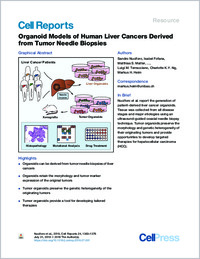
Organoid Models of Human Liver Cancers Derived from Tumor Needle Biopsies.
- Nuciforo S Department of Biomedicine, University Hospital Basel, University of Basel, 4031 Basel, Switzerland.
- Fofana I Department of Biomedicine, University Hospital Basel, University of Basel, 4031 Basel, Switzerland.
- Matter MS Institute of Pathology, University Hospital Basel, University of Basel, 4031 Basel, Switzerland.
- Blumer T Department of Biomedicine, University Hospital Basel, University of Basel, 4031 Basel, Switzerland.
- Calabrese D Department of Biomedicine, University Hospital Basel, University of Basel, 4031 Basel, Switzerland.
- Boldanova T Department of Biomedicine, University Hospital Basel, University of Basel, 4031 Basel, Switzerland; Clinic of Gastroenterology and Hepatology, University Hospital Basel, University of Basel, 4031 Basel, Switzerland.
- Piscuoglio S Institute of Pathology, University Hospital Basel, University of Basel, 4031 Basel, Switzerland.
- Wieland S Department of Biomedicine, University Hospital Basel, University of Basel, 4031 Basel, Switzerland.
- Ringnalda F Institute of Molecular Health Sciences, ETH Zurich, Otto-Stern-Weg 7, HPL, 8093 Zürich, Switzerland.
- Schwank G Institute of Molecular Health Sciences, ETH Zurich, Otto-Stern-Weg 7, HPL, 8093 Zürich, Switzerland.
- Terracciano LM Institute of Pathology, University Hospital Basel, University of Basel, 4031 Basel, Switzerland.
- Ng CKY Department of Biomedicine, University Hospital Basel, University of Basel, 4031 Basel, Switzerland; Institute of Pathology, University Hospital Basel, University of Basel, 4031 Basel, Switzerland.
- Heim MH Department of Biomedicine, University Hospital Basel, University of Basel, 4031 Basel, Switzerland; Clinic of Gastroenterology and Hepatology, University Hospital Basel, University of Basel, 4031 Basel, Switzerland. Electronic address: markus.heim@unibas.ch.
- 2018-08-02
Published in:
- Cell reports. - 2018
Biobank
cholangiocellular carcinoma
drug response
genetic heterogeneity
hepatocellular carcinoma
liver
needle biopsy
patient-derived organoids
patient-derived xenografts
Aged
Aged, 80 and over
Animals
Carcinoma, Hepatocellular
Cells, Cultured
Female
Humans
Liver Neoplasms
Male
Mice
Middle Aged
Organoids
Tissue Culture Techniques
English
Hepatocellular carcinoma (HCC) is the most common primary liver cancer and the second most frequent cause of cancer-related mortality worldwide. The multikinase inhibitor sorafenib is the only treatment option for advanced HCC. Due to tumor heterogeneity, its efficacy greatly varies between patients and is limited due to adverse effects and drug resistance. Current in vitro models fail to recapitulate key features of HCCs. We report the generation of long-term organoid cultures from tumor needle biopsies of HCC patients with various etiologies and tumor stages. HCC organoids retain the morphology as well as the expression pattern of HCC tumor markers and preserve the genetic heterogeneity of the originating tumors. In a proof-of-principle study, we show that liver cancer organoids can be used to test sensitivity to sorafenib. In conclusion, organoid models can be derived from needle biopsies of liver cancers and provide a tool for developing tailored therapies.
- Language
-
- English
- Open access status
- gold
- Identifiers
-
- DOI 10.1016/j.celrep.2018.07.001
- PMID 30067989
- Persistent URL
- https://sonar.ch/global/documents/77412
Statistics
Document views: 93
File downloads:
- Full-text: 0