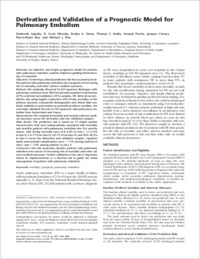
Derivation and validation of a prognostic model for pulmonary embolism.
- Aujesky D Division of General Internal Medicine, Clinical Epidemiology Center, University of Lausanne, Lausanne, Switzerland. drahomir.aujesky@chuv.ch
- Obrosky DS
- Stone RA
- Auble TE
- Perrier A
- Cornuz J
- Roy PM
- Fine MJ
- 2005-07-16
Published in:
- American journal of respiratory and critical care medicine. - 2005
Acute Disease
Aged
Cause of Death
Comorbidity
Decision Support Techniques
Discriminant Analysis
Female
France
Hospitals, University
Humans
Logistic Models
Male
Pennsylvania
Predictive Value of Tests
Prognosis
Pulmonary Embolism
ROC Curve
Risk Assessment
Risk Factors
Severity of Illness Index
Switzerland
English
RATIONALE
An objective and simple prognostic model for patients with pulmonary embolism could be helpful in guiding initial intensity of treatment.
OBJECTIVES
To develop a clinical prediction rule that accurately classifies patients with pulmonary embolism into categories of increasing risk of mortality and other adverse medical outcomes.
METHODS
We randomly allocated 15,531 inpatient discharges with pulmonary embolism from 186 Pennsylvania hospitals to derivation (67%) and internal validation (33%) samples. We derived our prediction rule using logistic regression with 30-day mortality as the primary outcome, and patient demographic and clinical data routinely available at presentation as potential predictor variables. We externally validated the rule in 221 inpatients with pulmonary embolism from Switzerland and France.
MEASUREMENTS
We compared mortality and nonfatal adverse medical outcomes across the derivation and two validation samples.
MAIN RESULTS
The prediction rule is based on 11 simple patient characteristics that were independently associated with mortality and stratifies patients with pulmonary embolism into five severity classes, with 30-day mortality rates of 0-1.6% in class I, 1.7-3.5% in class II, 3.2-7.1% in class III, 4.0-11.4% in class IV, and 10.0-24.5% in class V across the derivation and validation samples. Inpatient death and nonfatal complications were
CONCLUSIONS
Our rule accurately classifies patients with pulmonary embolism into classes of increasing risk of mortality and other adverse medical outcomes. Further validation of the rule is important before its implementation as a decision aid to guide the initial management of patients with pulmonary embolism.
An objective and simple prognostic model for patients with pulmonary embolism could be helpful in guiding initial intensity of treatment.
OBJECTIVES
To develop a clinical prediction rule that accurately classifies patients with pulmonary embolism into categories of increasing risk of mortality and other adverse medical outcomes.
METHODS
We randomly allocated 15,531 inpatient discharges with pulmonary embolism from 186 Pennsylvania hospitals to derivation (67%) and internal validation (33%) samples. We derived our prediction rule using logistic regression with 30-day mortality as the primary outcome, and patient demographic and clinical data routinely available at presentation as potential predictor variables. We externally validated the rule in 221 inpatients with pulmonary embolism from Switzerland and France.
MEASUREMENTS
We compared mortality and nonfatal adverse medical outcomes across the derivation and two validation samples.
MAIN RESULTS
The prediction rule is based on 11 simple patient characteristics that were independently associated with mortality and stratifies patients with pulmonary embolism into five severity classes, with 30-day mortality rates of 0-1.6% in class I, 1.7-3.5% in class II, 3.2-7.1% in class III, 4.0-11.4% in class IV, and 10.0-24.5% in class V across the derivation and validation samples. Inpatient death and nonfatal complications were
CONCLUSIONS
Our rule accurately classifies patients with pulmonary embolism into classes of increasing risk of mortality and other adverse medical outcomes. Further validation of the rule is important before its implementation as a decision aid to guide the initial management of patients with pulmonary embolism.
- Language
-
- English
- Open access status
- green
- Identifiers
-
- DOI 10.1164/rccm.200506-862OC
- PMID 16020800
- Persistent URL
- https://sonar.ch/global/documents/139321
Export to…
Statistics
Document views: 148
File downloads:
- Full-text: 0