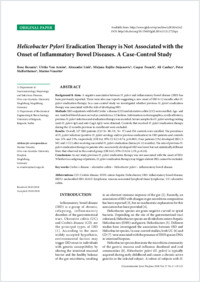
Helicobacter pylori eradication therapy is not associated with the onset of inflammatory bowel diseases. A case-control study.
- Rosania R Department of Gastroenterology, Hepatology and Infectious Diseases, Otto-von-Guericke-University Magdeburg, Magdeburg, Germany.
- Von Arnim U Department of Gastroenterology, Hepatology and Infectious Diseases, Otto-von-Guericke-University Magdeburg, Magdeburg, Germany.
- Link A Department of Gastroenterology, Hepatology and Infectious Diseases, Otto-von-Guericke-University Magdeburg, Magdeburg, Germany.
- Rajilic-Stojanovic M Department of Biochemical Engineering and Biotechnology, University of Belgrade, Belgrade, Serbia.
- Franck C Department of Gastroenterology, Hepatology and Infectious Diseases, Otto-von-Guericke-University Magdeburg, Magdeburg, Germany.
- Canbay A Department of Gastroenterology, Hepatology and Infectious Diseases, Otto-von-Guericke-University Magdeburg, Magdeburg, Germany.
- Malfertheiner P Institute of Surgical Pathology, University and University-Hospital of Zurich, Zurich, Switzerland.
- Venerito M Department of Gastroenterology, Hepatology and Infectious Diseases, Otto-von-Guericke-University Magdeburg, Magdeburg, Germany. m.venerito@med.ovgu.de.
- 2018-06-21
Published in:
- Journal of gastrointestinal and liver diseases : JGLD. - 2018
Adolescent
Adult
Aged
Anti-Bacterial Agents
Biological Products
Case-Control Studies
Colitis, Ulcerative
Crohn Disease
Female
Germany
Helicobacter Infections
Helicobacter pylori
Humans
Inflammatory Bowel Diseases
Male
Middle Aged
Risk Factors
Young Adult
English
BACKGROUND AND AIMS
A negative association between H. pylori and inflammatory bowel disease (IBD) has been previously reported. There were also case reports suggesting a new onset of IBD 6-12 months after H. pylori eradication therapy. In a case-control study we investigated whether previous H. pylori eradication therapy was associated with the risk of developing IBD.
METHODS
IBD outpatients with both Crohn´s disease (CD) and ulcerative colitis (UC) were enrolled. Age- and sex-matched blood donors served as controls in a 1:2 fashion. Information on demographics, medical history, previous H. pylori infection and eradication therapy was recorded. Serum samples for H. pylori serology testing (anti-H. pylori-IgG and anti-CagA-IgG) were obtained. Controls that received H. pylori eradication therapy during the 12 months previous to enrollment were excluded.
RESULTS
Overall, 127 IBD patients (CD N= 90; UC N=37) and 254 controls were enrolled. The prevalence of H. pylori infection (positive H. pylori serology and/or previous eradication) in IBD patients and controls was 11% and 23%, respectively (OR 0.4, 95% CI 0.21-0.74, p<0.003). Four patients (3%) developed IBD (3 MC and 1 CU) after receiving successful H. pylori eradication (latency 6-12 months). The rate of previous H. pylori eradication therapy in patents who successively developed IBD was lower but not statistically different from that observed in the control group (OR 0.43, 95% CI 0.14-1.29, p=0.16).
CONCLUSIONS
In our study previous H. pylori eradication therapy was not associated with the onset of IBD. Whether in a subgroup of patients, H. pylori eradication therapy may trigger a latent IBD, cannot be excluded.
A negative association between H. pylori and inflammatory bowel disease (IBD) has been previously reported. There were also case reports suggesting a new onset of IBD 6-12 months after H. pylori eradication therapy. In a case-control study we investigated whether previous H. pylori eradication therapy was associated with the risk of developing IBD.
METHODS
IBD outpatients with both Crohn´s disease (CD) and ulcerative colitis (UC) were enrolled. Age- and sex-matched blood donors served as controls in a 1:2 fashion. Information on demographics, medical history, previous H. pylori infection and eradication therapy was recorded. Serum samples for H. pylori serology testing (anti-H. pylori-IgG and anti-CagA-IgG) were obtained. Controls that received H. pylori eradication therapy during the 12 months previous to enrollment were excluded.
RESULTS
Overall, 127 IBD patients (CD N= 90; UC N=37) and 254 controls were enrolled. The prevalence of H. pylori infection (positive H. pylori serology and/or previous eradication) in IBD patients and controls was 11% and 23%, respectively (OR 0.4, 95% CI 0.21-0.74, p<0.003). Four patients (3%) developed IBD (3 MC and 1 CU) after receiving successful H. pylori eradication (latency 6-12 months). The rate of previous H. pylori eradication therapy in patents who successively developed IBD was lower but not statistically different from that observed in the control group (OR 0.43, 95% CI 0.14-1.29, p=0.16).
CONCLUSIONS
In our study previous H. pylori eradication therapy was not associated with the onset of IBD. Whether in a subgroup of patients, H. pylori eradication therapy may trigger a latent IBD, cannot be excluded.
- Language
-
- English
- Open access status
- green
- Identifiers
-
- DOI 10.15403/jgld.2014.1121.272.hpy
- PMID 29922755
- Persistent URL
- https://sonar.ch/global/documents/47560
Statistics
Document views: 28
File downloads:
- Full-text: 0